
AI Models, Autocomplete, and Setting Fair Expectations in Practice
How model choice and assistant features change what you are training. Tips for learners and reviewers when AI is in the loop.
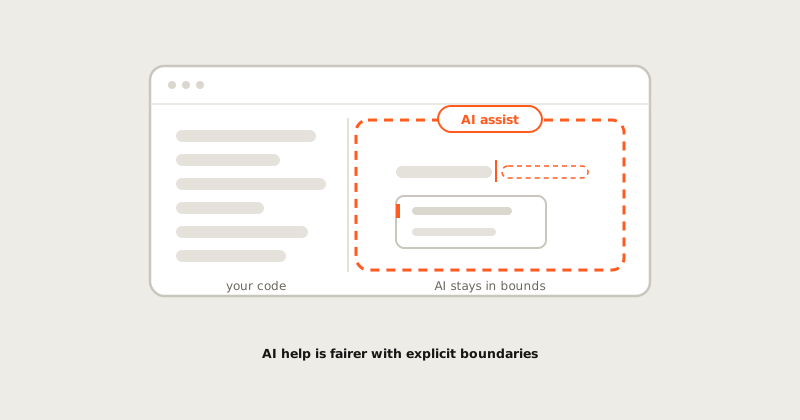
When an environment offers model-assisted features, the question is not only "is this allowed?" It is also what skill are you trying to grow right now?
Separate training modes from exam modes
In training, assistants can accelerate feedback loops:
- suggest API names
- catch syntax slips
- propose tests you forgot
In exam-shaped settings, the same features can hide gaps you need to see. Treat transparency as a feature. Know what is on, what model you are using, and what the rubric expects.
The feature did not change; your goal did. Autocomplete that accelerates a learning loop is the same autocomplete that lets you pass a verification rep without actually retaining the idea. So the honest question is never just "is this cheating?" It is "what do I want to be able to do unaided later?" If the answer is "recall this API under pressure," the assistant is a blindfold this session. If the answer is "understand how these pieces fit," it is a teacher. Same tool, opposite effect, which is exactly why naming the mode beats banning the feature.
For learners (build a personal policy)
A practical split:
- Exploration sessions keep assistants on and reward depth of understanding.
- Verification sessions turn assistants off (or limit them) so you prove you can reproduce ideas.
- Timed reps should mirror the rules of the event you are training for.
For reviewers (score reasoning, not novelty)
If candidates used tools, look for evidence they understood the result: tests, invariants, edge cases, and clear explanations beat "clever one-liners."
The bigger picture
The industry is still converging on norms. Until then, clarity wins. Prefer platforms that document behavior over platforms that imply it.
For a broader skills stack, skim the FAANG prep roadmap next.
How to read this update
The important question is not only what shipped. It is what new evidence the product can now preserve. For interview prep work, a useful release should make the next session easier to understand: what happened, why it mattered, and what someone can do with the result afterward.
That is the bar we use for field notes. A feature is stronger when it turns a hidden process into something reviewable: a timeline, a report, a map, a score explanation, a replay, or a teacher-facing control. The surface can stay simple, but the evidence behind it should get harder to hand-wave.
What to watch next
The next pass should keep tightening the connection between the public story and the product artifact. If a learner reads a note about practice, they should be able to find the loop in the product. If a teacher reads about classroom control, the setting should be visible. If a hiring team reads about assessment evidence, the report should show the trail.
That is a lesson worth borrowing from the strongest developer tools without copying their design: the best content feels like product memory. It does not decorate the roadmap. It makes the product easier to trust.