
Children Under 13 Can Join With a Parent's Approval
Every form for signing up now asks for a birth month and year. A child under 13 can sign up, and the account starts working once a parent approves it by email.
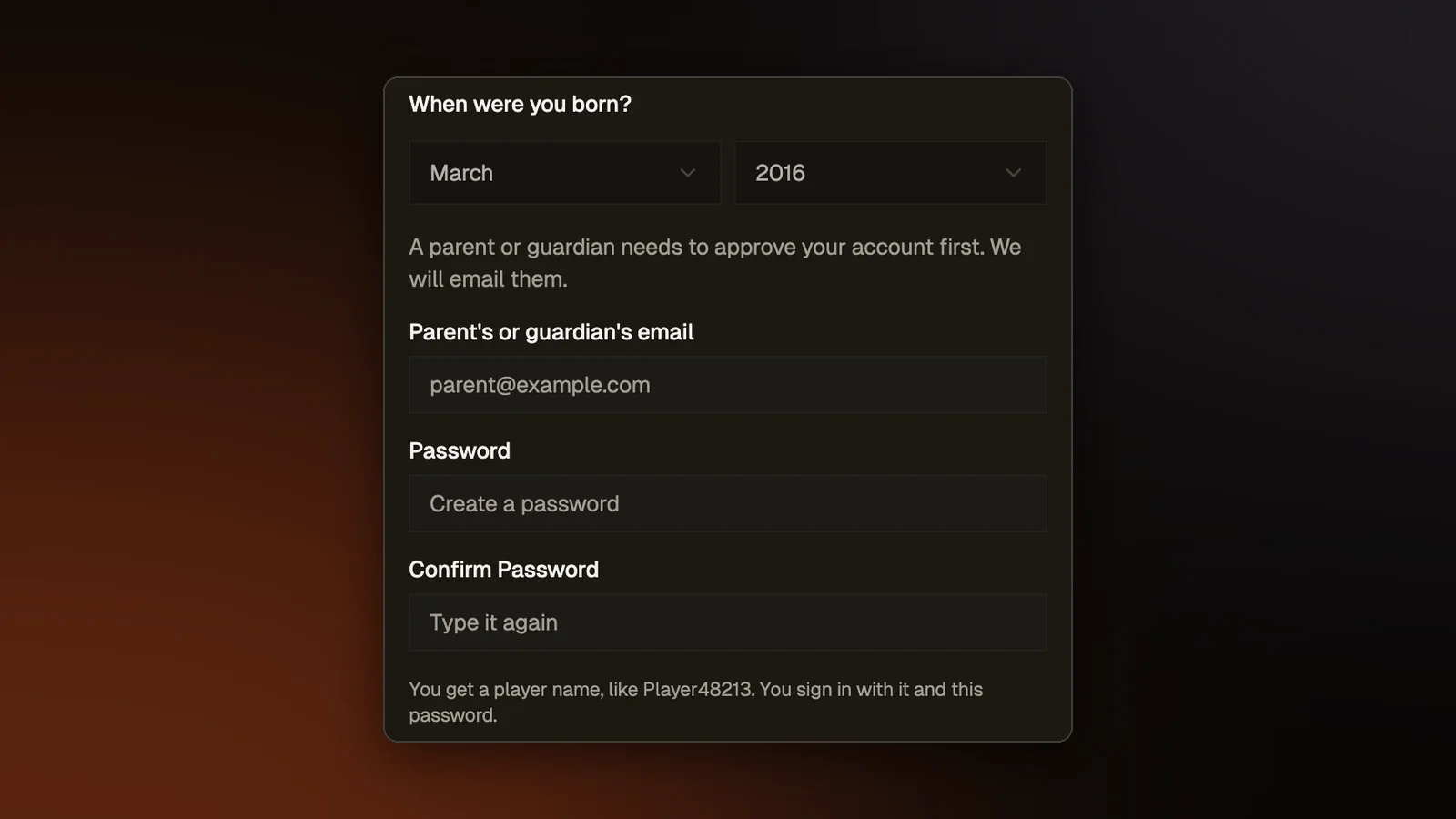
Until this change, a child under 13 could use AlgoArena only through a class run by their teacher or school. A younger student who wanted to practice at home could not sign up. In the United States, the Children's Online Privacy Protection Act requires a parent's consent before a website collects personal information from a child under 13. Children can now make their own account, which starts working once a parent approves it.
One question for everyone
Every form for signing up now asks "When were you born?" with a month and a year. That includes the Sign up page and the box you fill in after signing in with Google or GitHub. The month and year menus start empty and give no hint of which answer leads where. Since the form never asks for the day, someone whose 13th birthday falls in the current month counts as under 13 until that month is over.
The browser remembers an answer under 13 and locks the question to it, so going back and picking an earlier year does not skip the parent's step.
The parent's step
A child under 13 does not give their own email address or pick a username. The form asks for a parent's or guardian's email instead and tells the child that a parent needs to approve the account first. The account gets a player name made of "Player" and a number, such as Player48213. A child who signs up with a password uses that player name to sign in.
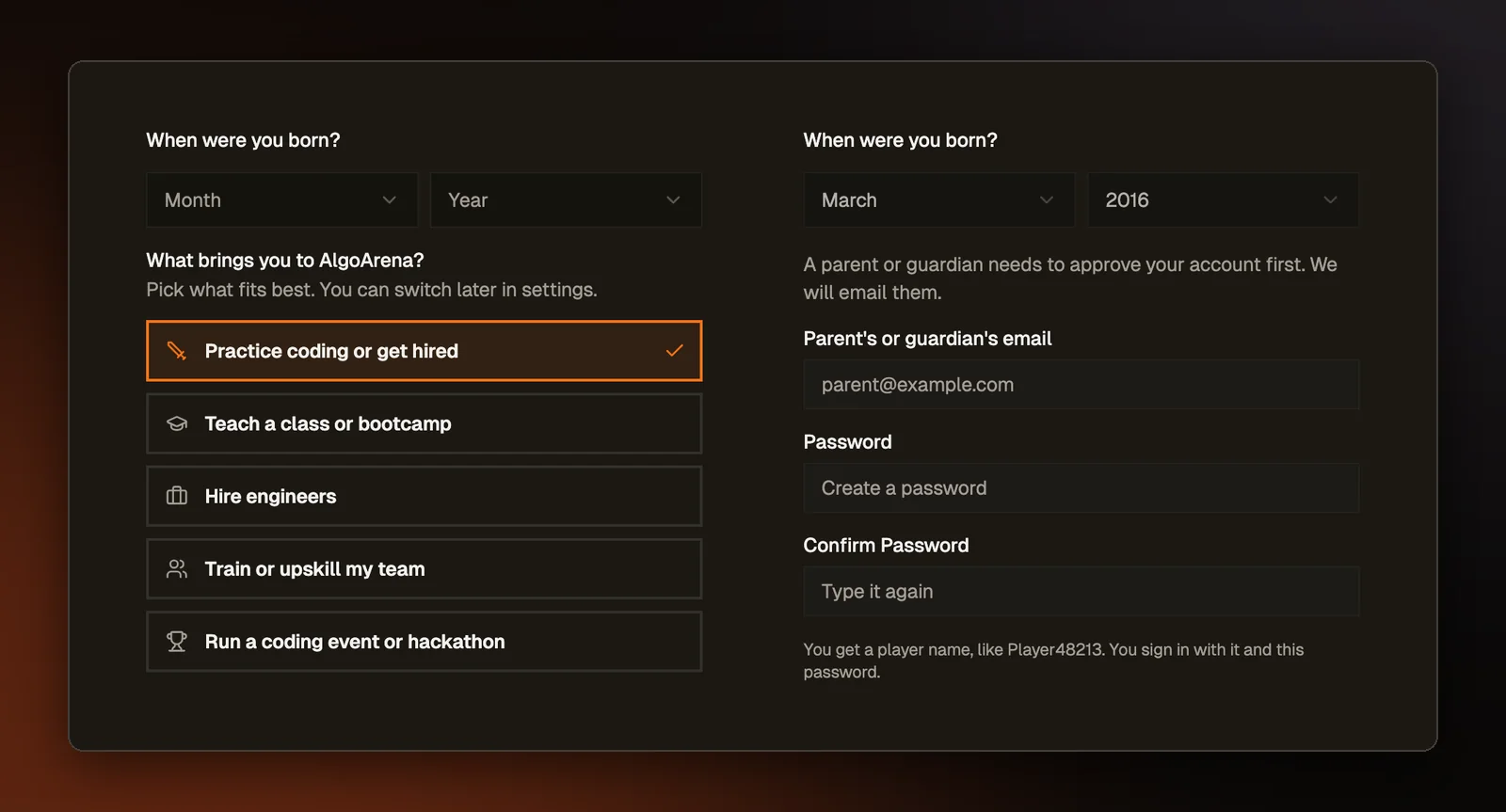
The account is created switched off, so it cannot sign in yet. The parent gets an email explaining that someone, most likely their child, is making an account on a website for learning to code. The email lists what we would collect after approval:
- account details, meaning the player name, password, birth month and year, and the parent's email address
- the code and answers the child submits
- their conversations with the AI tutor
- how they worked, such as code runs, edits and time spent
The email says we use this only to run AlgoArena for the child, and that we never sell it, never use it for ads and never use it to train AI. If the parent ignores it, the account never starts working.
The email's Approve button opens a page that shows the player name, the day the account was made and its status. Approving there turns the account on and sends a second email confirming it. That email has a link to cancel and delete the account, in case the approval was not the parent's. From the link in either email, the parent can delete the account and everything in it at any time. If nobody approves within 14 days, the account and the request are deleted. Each link works for 30 days. After that it opens a page that offers to email a new one.
A child who tries to sign in with their player name before approval sees "Your account is waiting for your parent to approve it. Ask them to check their email."
What these accounts cannot do
The law allows this kind of email approval only while a child's information stays inside the site, so these accounts have limits. The public name is always the player name, photo uploads are refused, and the profile page has no fields for a bio, a location or links. A child's projects in Builder, our page for making apps with AI, cannot be published to the public showcase, and the link that opens a project for other people can only be set to Only me or People I invite. Voice input is off there and in mock interviews, as is chat after a battle. These accounts get no newsletter and no reminder emails.
Our server checks these limits from a mark that only the server can set, which the account carries from the moment it is made. For publishing, photo uploads and project links, a check that fails is treated as a child's account, so an error never opens those features.
Classes work as before
A child can still use AlgoArena through a class their teacher or school runs. For a class, the school agrees to its educational use on the parents' behalf, as our terms describe. We updated the terms the same day to cover both routes, and the privacy policy now lists the birth month and year among what we collect.