Learn to code with words, not syntax.
A gamified course that teaches computational thinking through plain-English commands. In any language. On any device. No prior coding experience required. Think Scratch for the AI era.
AlgoArena already hosts a five-figure problem bank with test cases across 16 languages. For about eight months we have been curating external sets, merging duplicates, hand-checking quality, and using AI to draft and verify new items. That same pipeline is how we plan to grow the Vibecoding Course once it opens broadly.
How it looks
Plain-English commands. Increasingly hard tasks.
Players type natural language commands to a friendly robot named Ada. Each task gets a little harder, and learners pick up the building blocks of programming without ever touching a curly brace.
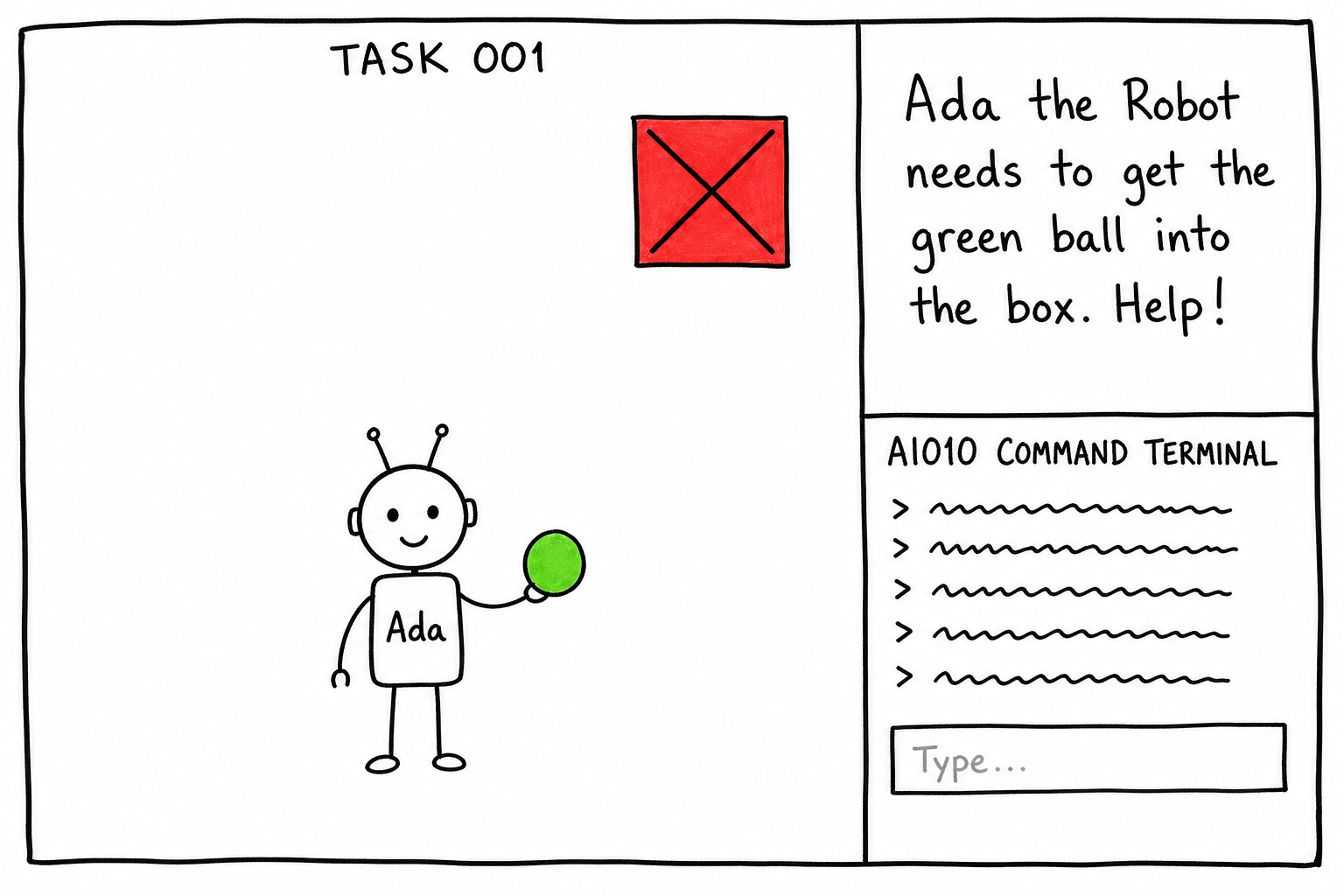
TASK 001
Sequencing
One ball. One box. Tell Ada what to do, in your own words.
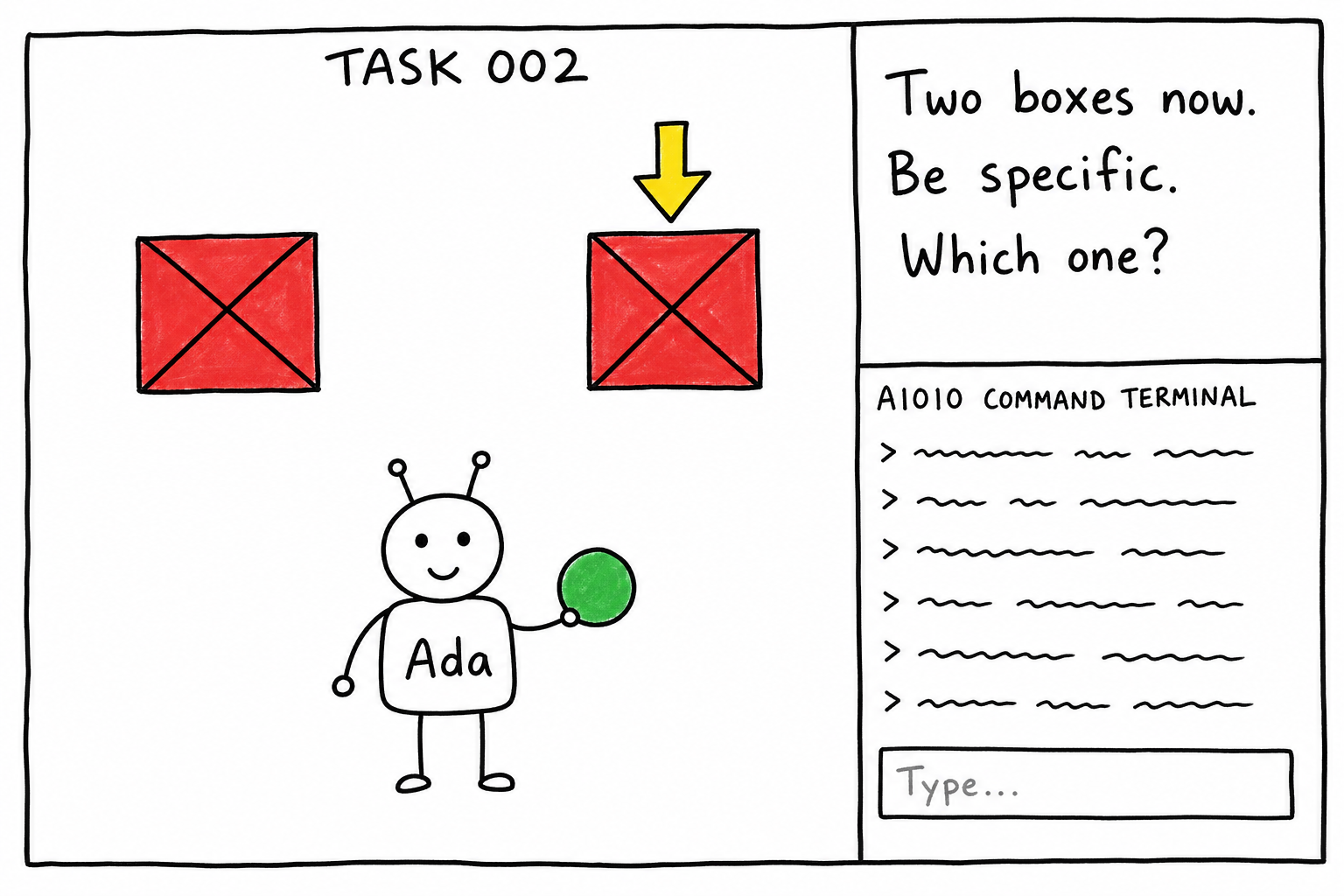
TASK 002
Disambiguation
Two boxes now. "Put it in the box" is no longer enough. Learners discover precision the same way real engineers do.
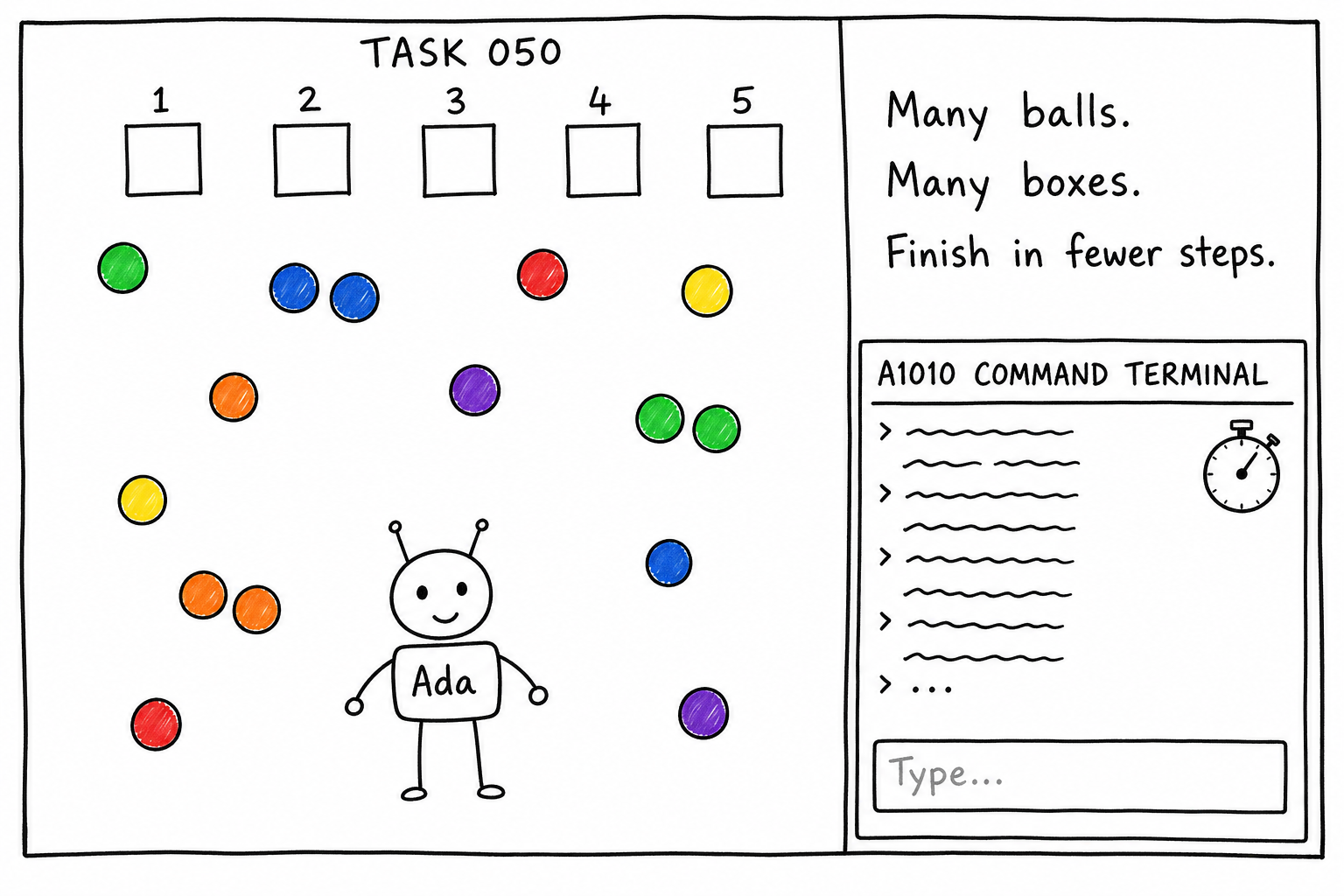
TASK 050
Optimization
Hundreds of objects. A real runtime budget. Players naturally reach for loops, sorting, and abstractions.
The progression
From a single command to thinking algorithmically.
Every stage adds one new pressure. Players naturally start reaching for loops, conditionals, and abstractions. They are doing computer science. They just don't know it yet.
Plain commands
Sequencing
Move. Pick up. Drop. Players learn that order matters, and that words can drive behavior.
Disambiguation
Conditionals
Two of the same object. Players learn to specify, qualify, and handle the edge case.
Many objects, many rules
Loops & abstraction
Twenty balls, three boxes, color rules. Doing it by hand is painful. Loops feel inevitable.
Optimize
Complexity
Finish in fewer steps. Use less time. Players develop a real intuition for efficiency.
Toggle the code view, anytime.
Every command a learner types can be revealed as actual Python, JavaScript, or pseudocode. The course meets each learner where they are. No syntax for those who want it, full code for those who don't.
// origin
We Googled "learn to vibecode" and got nothing.
Early 2026. Every coding-practice platform on the internet was still teaching the old way. Memorize patterns, write syntax, race the clock. Meanwhile the actual job had moved. Real engineers were spending their days writing prompts, reviewing AI output, and shipping faster than ever.
We searched for a course that taught computational thinking through natural language. Something a 10-year-old could use, in any language, on any device. A real on-ramp to the AI era.
There were zero useful results.
Scratch was that on-ramp for a generation of kids in the 2000s. Nobody had built the equivalent for the AI era. So we started.
Scratch gave a generation of kids their first "I can do this" moment with code. The AI era needs the same thing. We are building it.
Built on what we already shipped
Parts of the stack already ship today.
Classroom Mode, Agentic Builder, and our public AI model benchmark are live products with real users. Vibecoding-style OA flows for technical hiring are still in development, but they are being built on the same platform primitives models, in-browser environments, and evaluation tooling that the Vibecoding Course will plug into. That lowers infrastructure risk for the curriculum build.
We already ship 10,000+ curated coding problems with verification tests. For roughly eight months we have run a dedicated pipeline to find resources, ingest community and commercial banks where licensing allows, and generate net-new items with AI in the loop plus human review. That is the muscle we will reuse to author and scale vibecoding-style course challenges, which is why we are confident the Vibecoding Course can grow quickly once it is live.
AI-native OA (Vibecoding-style)
In developmentWe are building natural-language and agent-assisted assessment flows for technical hiring. They are not generally available yet, but they share the same foundations as the course.
Agentic Builder
LiveFull AI codegen workspace, browser file system, and one-click GitHub export. The same agent loop the course will sit on top of.
AI Model Benchmark
LiveMeasures prompt-to-apply efficiency, code survival rate, and per-model performance. Lets us pick the cheapest, best model for classroom-scale delivery.
Classroom Mode
Piloted at Bryn MawrLive in-class quiz engine purpose-built for CS. Piloted with 11 students in a live course at Bryn Mawr College. Proves the educator distribution channel and gives the course a built-in path into lecture halls.
Who it's for
Globally applicable. K-12 to corporate.
Anyone can instruct Ada in their native language and watch it become real code. Built to run on a low-bandwidth phone in Lagos, a Chromebook in a Texas classroom, and a laptop in a Fortune 500 onboarding session.
K-12 students
Ages 10 and up. Game-based learning that builds CS confidence with zero syntax friction.
CS professors & career centers
Drop-in module for intro CS, AI literacy units, and career-readiness programs. Certification ready.
LMIC partners & NGOs
Language-agnostic, low-bandwidth, no-account-required. Built for global rollout from day one.
Bootcamps
Pre-bootcamp on-ramp that gets students fluent in prompting before week one.
Corporate L&D
Onboarding and AI fluency for non-technical teams. PMs, marketers, ops, and analysts.
Anyone curious
Self-paced. Free entry tier. Learn the way developers actually work today.
A senior CS faculty member at the University of Cambridge is currently engaging with us on cost-aware, AI-first curriculum for African students. We are sharpening the LMIC framing of the course around that input.
Ongoing academic collaboration. Educator interest welcome.
A certificate that means something.
Completion can lead toward AlgoArena vibecoding certification: Beginner, Builder, and Professional. Each level is tied to a portfolio of solved tasks, verification habits, and AI-output judgment. Institutional licensing available for schools, universities, and bootcamps.
Steer AI through simple tasks with clear natural-language instructions.
Plan, prompt, edit, verify, and recover when the first output is wrong.
Use AI safely under constraints and explain tradeoffs to another person.
Be first in line.
Join the waitlist. Pilot partners and educators get priority access.