
Stress Is the Skill: Why 5,000 Solved Problems Won't Get You Hired
You can grind LeetCode forever and still freeze in a live interview. Performance under pressure is its own skill, and you can only train it under pressure.
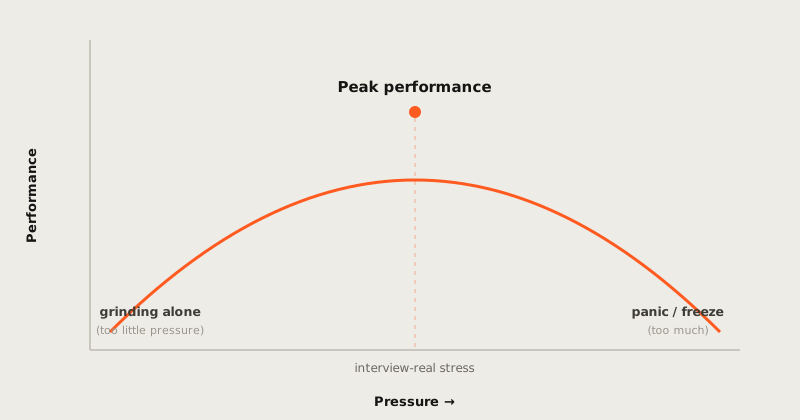
You can solve 5,000 LeetCode problems and still fall apart in a 45-minute interview. I have watched it happen, and I have felt it. The problem is that grinding problems alone, in a quiet room, on your own clock, trains none of the thing the interview actually tests: performing under pressure while a stranger watches.
The graph nobody studies
Plot performance against pressure and you get an inverted U. Too little pressure and you coast: comfortable, unhurried, never forced to recall fast or explain yourself. Too much and you freeze. The peak sits in the middle: enough stress to sharpen you, not enough to break you.
Solo grinding lives on the far left of that curve. It builds knowledge, but it never moves you toward the peak, because there is no clock you respect, no opponent, and no one to explain your thinking to mid-solve. Then the interview drops you, untrained, straight onto the right side of the curve, where you panic.
What the interview actually measures
A live technical screen is not a knowledge test. If it were, an open-book quiz would do. It measures three things at once, under load:
- Can you still think when your heart rate is up?
- Can you communicate your reasoning while you work, not after?
- Can you recover when your first idea is wrong and the clock is running?
None of those are trainable alone. They are stress skills, and stress skills only develop under stress.
Why we built battles
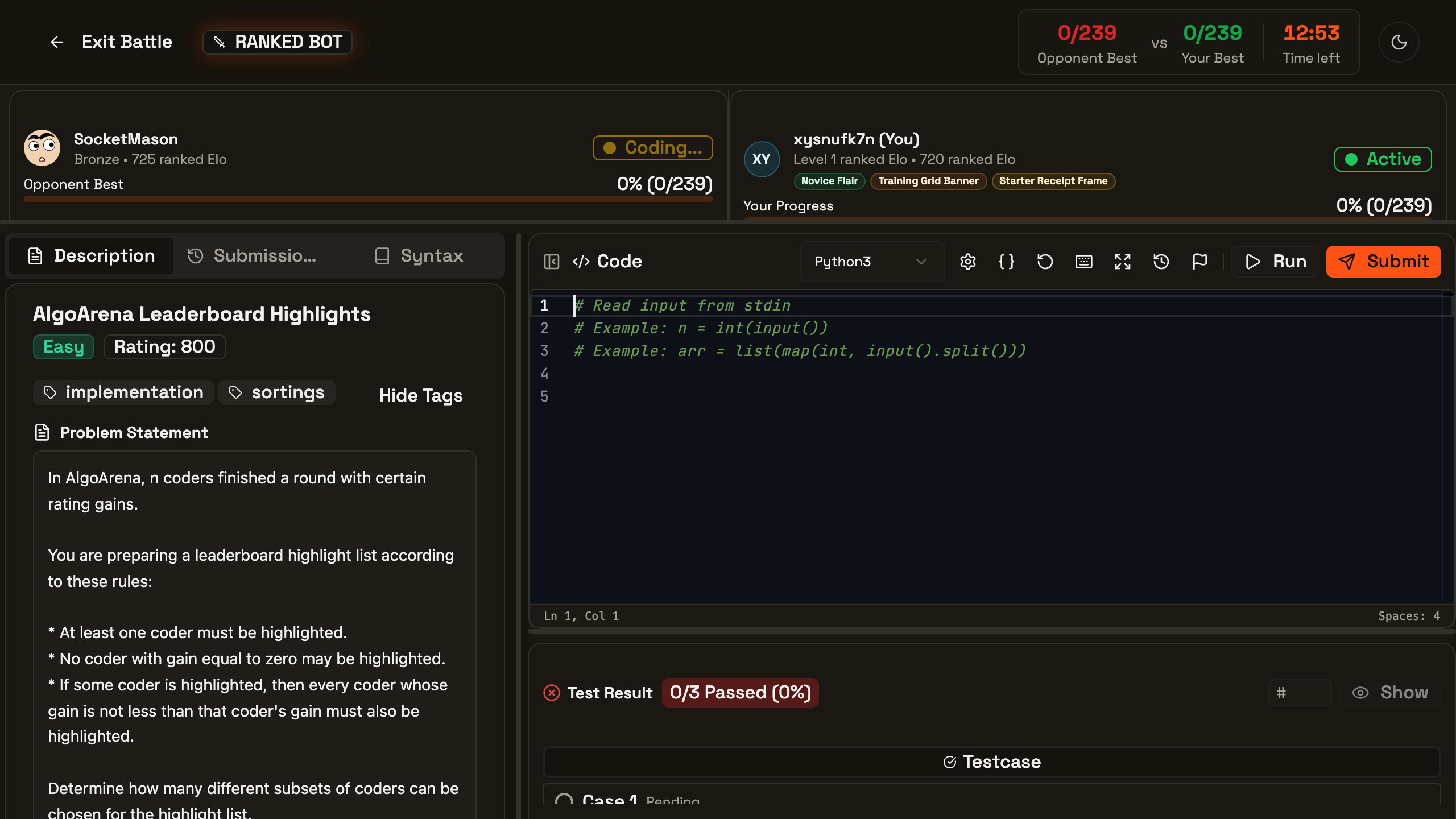
That gap is the whole reason AlgoArena has ranked 1v1 battles instead of just a problem list. A real opponent, a live clock, an ELO number on the line, and a result that is public the moment it ends. It is uncomfortable on purpose. The first few battles feel awful, and that discomfort is the training. You are inoculating yourself, moving up the curve, so the real interview lands in your peak band instead of your panic band.
It is the same reason athletes scrimmage and musicians perform before the recital. You do not rise to the occasion. You fall to the level of your practice. So practice the occasion.
You can raise the pressure in steps. A friendly battle with someone you invite has an opponent and a clock but leaves both ratings alone. Ranked adds the rating, and a harder problem moves it more.
A battle never asks you to explain yourself, so it trains the clock and the opponent but not the talking. For that part, the practice interview has Rena play the interviewer out loud while you talk through your approach and code.
Knowledge is the floor, not the ceiling
The 5,000 problems are not wasted. Knowledge is the floor, because you cannot perform what you do not know. But past a point, the marginal problem teaches you less than a single battle where you have to use what you know with something on the line. Build the floor with practice. Raise the ceiling with pressure.
If your last few interviews felt like you knew the answer but could not show it in time, you have a stress problem, so train it like one.