 AlgoArena Team 3 min read
Bounded AI Practice in the Classroom
A field note on hint-only Rena, the switch the teacher controls, and why classroom assistance should coach thinking without handing over solutions.
Classroom AI has a different job from a coding assistant in a private workspace. In class, the goal is to help students notice the right next idea instead of finishing the exercise as quickly as possible, which is why hint-only Rena matters.
The boundary
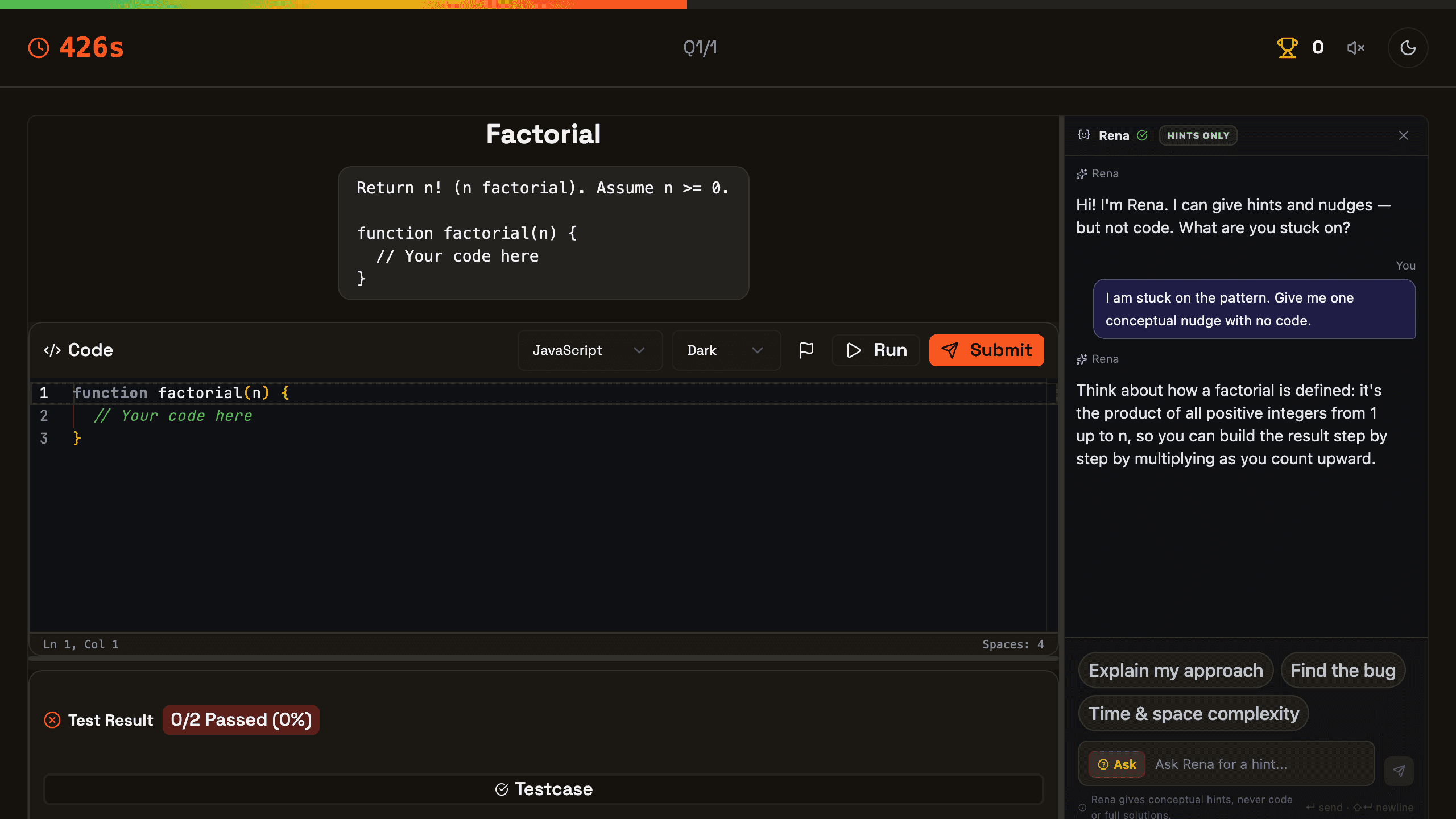
Teachers can enable AI help that gives conceptual nudges without writing code or handing over a full solution. The student still has to reason about the invariant, choose the structure, edit the code, and run the tests.
That boundary, help with the thinking but never the typing, is what lets a teacher trust that the work is still the student's.
What the student sees
Hint-only Rena appears only on coding questions, where it opens as a panel beside the problem. Its greeting says up front that it gives hints and nudges but no code. Three starting prompts ask it to explain the student's approach, find the bug, or talk through time and space complexity.
Rena reads the problem statement and the student's current code, so a hint can respond to the approach the student actually took. A student who joined as a guest with the session code gets the same help as one who signed in.
How the boundary holds
Rena writes no code and no pseudocode, not even one line, and it never hands back a corrected copy of the student's code. Its hints are conceptual, such as the idea underneath the problem, a data structure or pattern worth considering, an edge case to check, or a leading question. When a student asks for the solution outright, it declines and gives a nudge instead. Hints stay short, get more specific only when the student is still stuck after the last one, and stick to the problem in front of them.
Those rules are backed by a second check that does not depend on the model following them. If a reply contains a block of code anyway, the block is removed before the student sees it and replaced with a note that Rena only gives hints.
Why "no AI" is not the only safe answer
A blanket ban can look clean, but it often dodges the harder teaching question. Students will use AI outside the classroom. The useful skill is learning how to ask, inspect, test, and revise without outsourcing the thinking. Bounded AI lets a classroom practice that skill in a controlled way.
Teacher control stays central
The important product decision is that the teacher controls the mode. The switch sits in the quiz setup and stays off until the teacher turns it on for that session. A teacher can leave it off for a checkpoint quiz and turn it on for a practice round the next day, which keeps classroom AI from becoming a generic chatbot bolted onto a lesson.
The learning loop
Hint-only Rena fits the balance a live classroom has to strike between keeping the group moving and noticing who is lost. It can help a stuck student move one step forward while preserving the teacher's ability to debrief the room.
AI should not make classrooms less human. Used with boundaries, it can make the teacher's actual work easier to see.