
Your First Five Battles Are Casual
A new player's first five battles are now casual, with the rating moving out of sight until ranked unlocks. Ratings use Glicko-2, and the server decides how every battle ends.
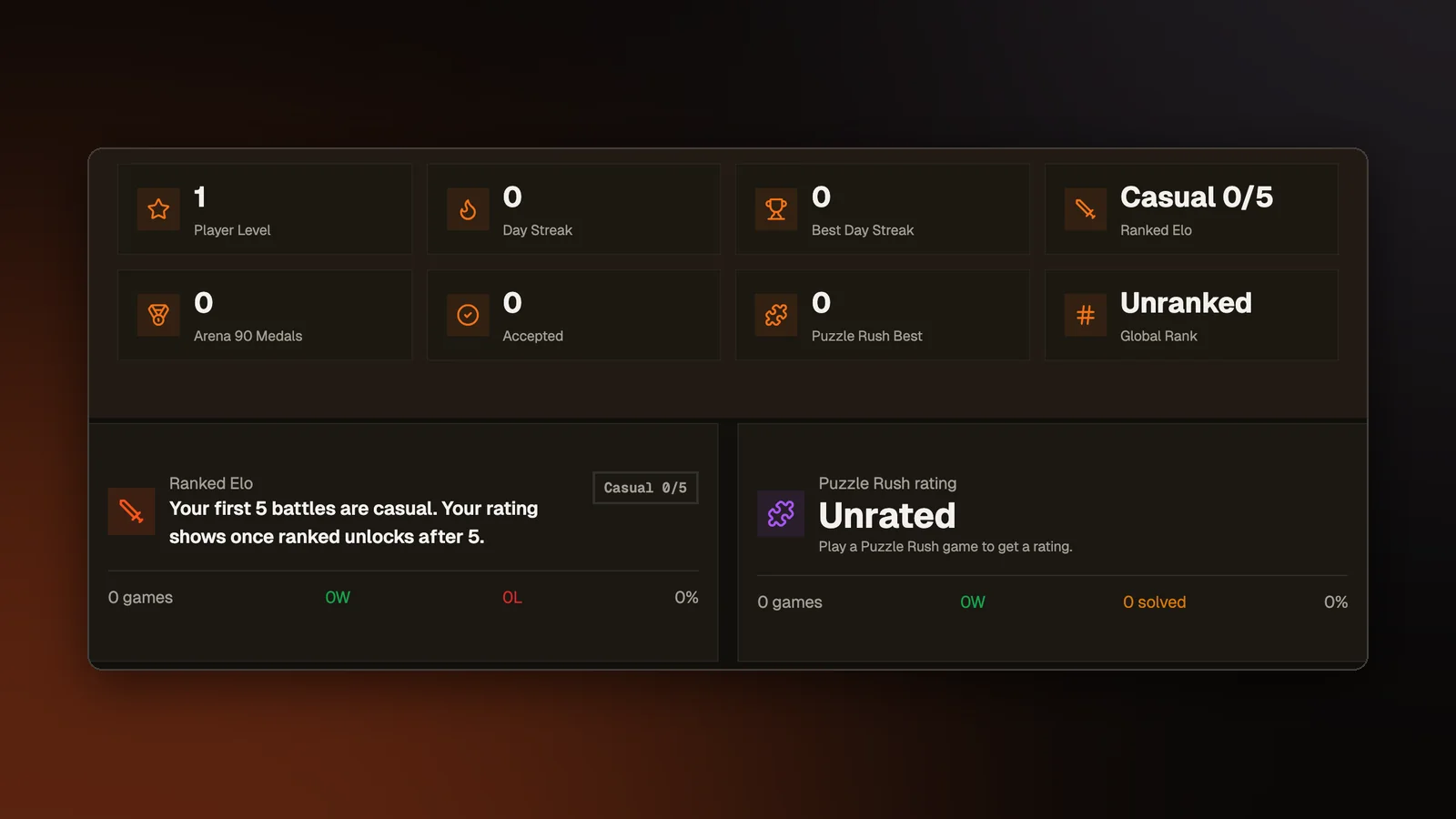
A new player's battle rating used to show from the very first battle. One loss on an unlucky problem moved a number that had nothing else behind it, and that number then set how hard the next problem would be. In the last days of September and the first days of October, we changed how a new player starts. The first battles are casual, a new rating system finds your level, and the server decides every result.
Five casual battles
A new account's first five battles that are played to the end are casual. A battle is played to the end when you solve the problem, when your opponent finishes first, or when the clock runs out. The battle card counts them for you with a line such as "2 of 5 casual battles done. Your rating shows once ranked unlocks after 5." Leaving a casual battle does not change your rating or your win and loss record and does not count toward the five, though it shows as a loss in your match history.
Your rating moves from the very first of those battles, but the number stays hidden until ranked unlocks, so we went through every place it could appear. Those battles show as Casual in Recent Activity and match history, with no rating change, and the match page shows no ratings at all. In the lobby and on the battle page, your opponent appears without a rating, since an opponent's rating sits close to yours and would give your own number away. There are no notices about reaching a new tier, no row on the ranked leaderboard, and no global rank on your profile. Puzzle Rush has a rating of its own, which still shows.
The battle card has a Ranked and Casual switch above Find a Match, and Ranked stays locked until your fifth battle is done. After that your rating appears, both sides of the switch work, and it remembers your last choice in that browser. Casual after unlocking works differently from the first five. It has its own queue and is unrated, so neither your rating nor the leaderboard moves. Anyone who already had five or more battles before this change was unlocked from the start.
Friend challenges and rematches are always unrated. The challenge dialog no longer offers a Rated option, which used to fail as soon as your friend accepted.
How the rating moves
Battle ratings now use Glicko-2, a rating system designed by Mark Glickman. Next to your rating it keeps a second number that says how sure it is of that rating. Everyone starts at 800 with that uncertainty high, so early results move the rating a long way. As results come in, the uncertainty shrinks and each battle tends to move the rating less. The uncertainty never drops below a floor, so a player who has been here a long time can still climb or fall.
Each battle counts as two results. One is the result against your opponent, which is a win, a loss, or a draw. The other treats the problem itself as an opponent rated at the problem's difficulty, which you beat by passing every test while the match is live. Solving a problem rated well above you moves your rating up more than solving an easy one, and missing an easy problem costs more than missing a hard one.
While the system is still unsure of your rating, matchmaking picks problems below it, and a brand new player gets true beginner problems. Signup no longer sets your starting rating from a skill level you pick, so every new player starts at the same rating and is placed by their first battles alone.
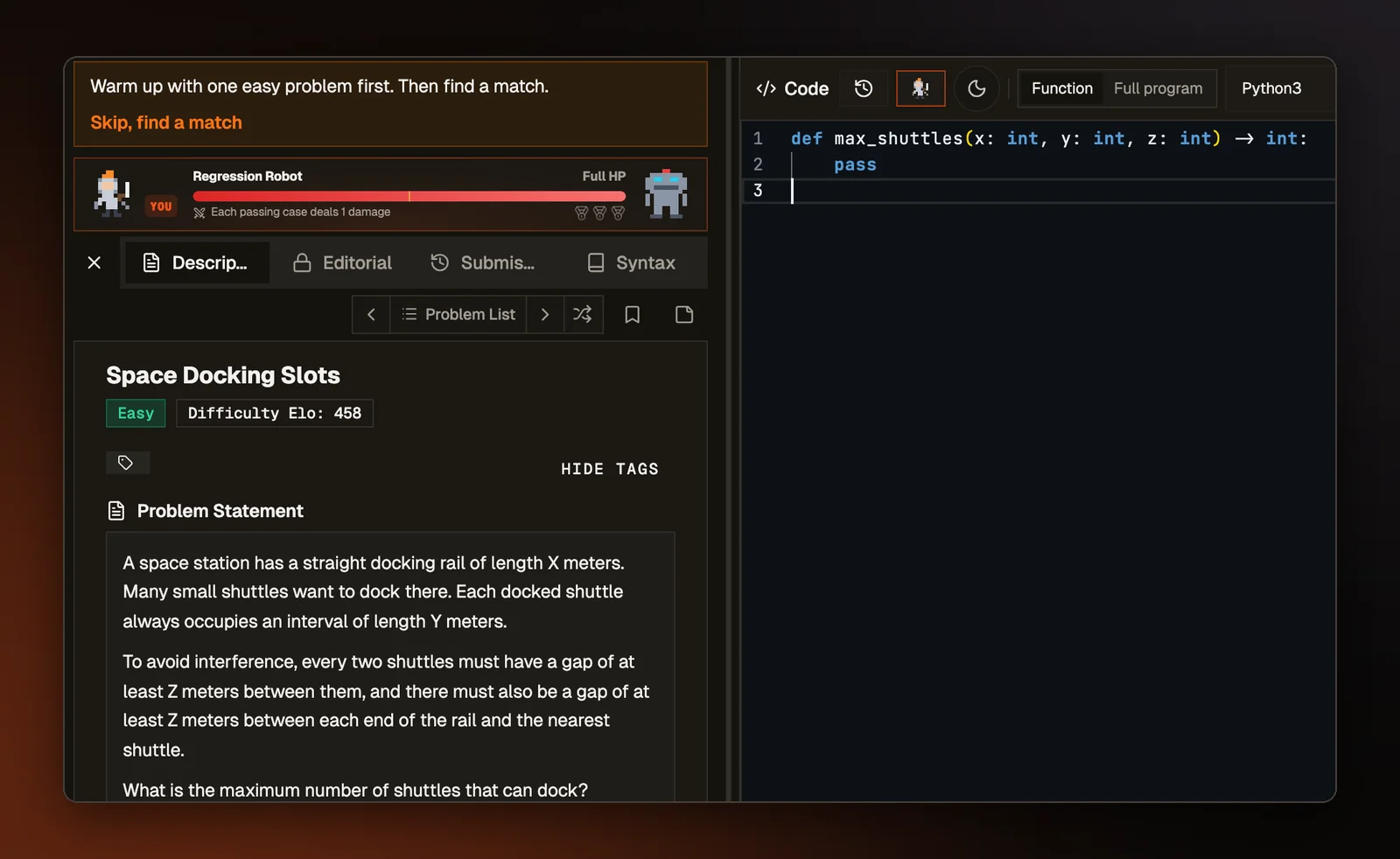
The first time someone with no battles and no solved problems presses Find a Match, they get one easy practice problem before any opponent, with no clock, so the editor is already familiar when a timer first runs. After they solve it or skip it, Find a Match works as usual.
The server decides who won
The server records how every battle ends, from its own judging of each submission, the judging described in Hidden Tests Stay on Our Servers. A solve counts when that judging shows a submission passed every test. If the clock runs out first, the side whose judged submissions passed more tests wins, with a tie counted as a draw. A submission sent just as the clock reaches zero still counts.
A battle that never reached an ending, for example because the page was closed partway through, used to stay open with nothing to close it. A job that runs every hour now closes any battle that is well past its time limit, with no winner and no rating change.