
Practice for design, review and debugging rounds
New practice for interview rounds that are not algorithm problems: a system design graded after an AI interviewer's questions, pull requests to review, systems built in levels, and programs with planted bugs.
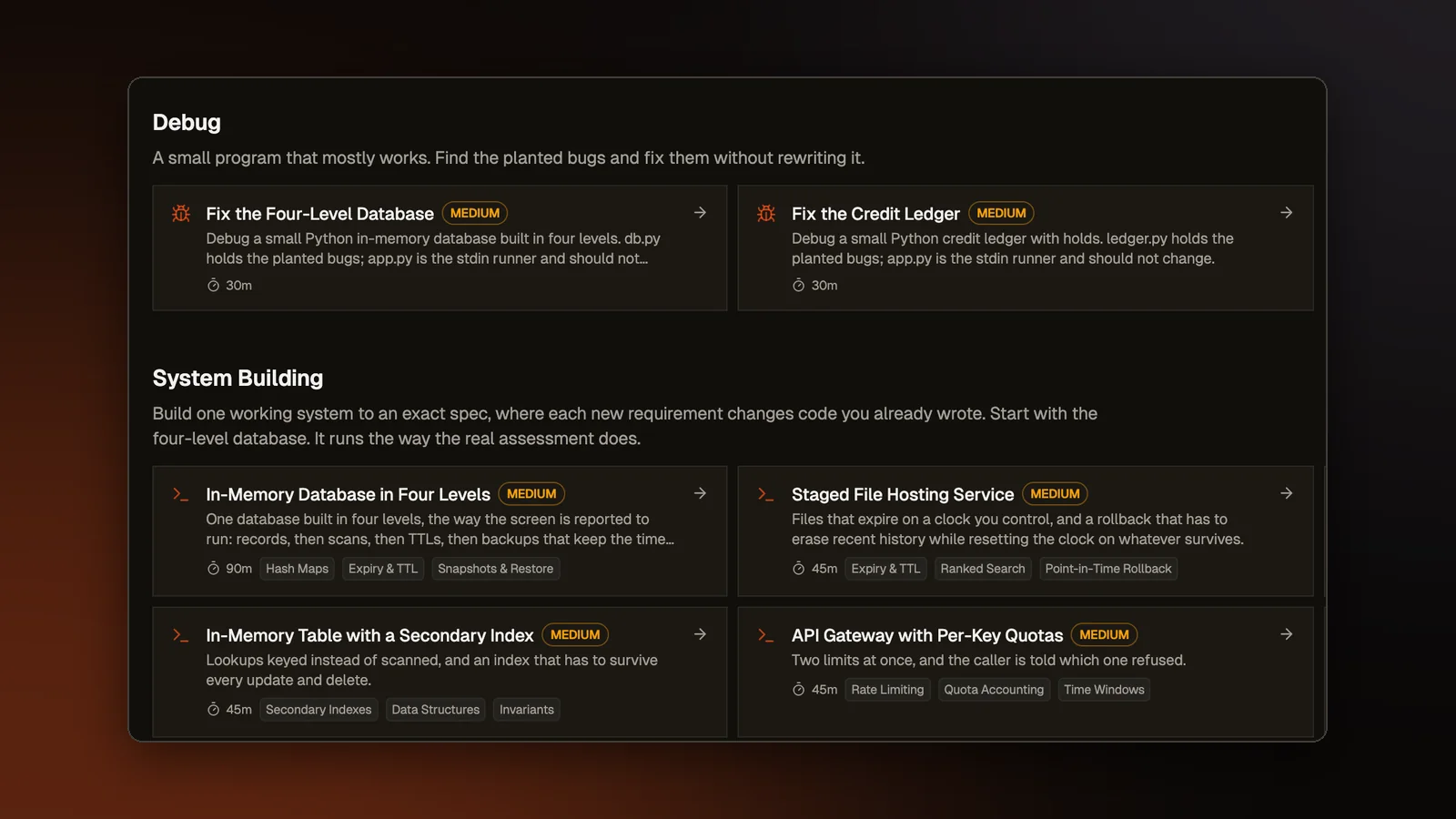
Many coding interviews now include rounds that are not algorithm problems. Candidates describe being asked to design a system and defend it, to review a teammate's pull request, to fix a program with planted bugs, or to build one system in levels where each level changes the code written for the last. Our practice library was mostly algorithm problems and Build a System projects. We added practice for each of these rounds.
A design, then questions about it
Design practice gives you a prompt to write a design for, such as the chat service behind an AI assistant or search over two billion documents. An AI interviewer then reads your design and asks two or three questions about what you wrote, the way an interviewer presses on the weak spots. These are the same kind of questions our assessments ask participants about their own code, asked here about a design. You answer, and the whole discussion is graded line by line against the prompt's rubric. The grade says what was strong and what was missing. The rubric stays on our server until the grade shows it.
There are four prompts. They sit in Build a System above the projects, where the same filters apply to them. A free account gets one graded design a day. Pro and Ultimate accounts have no daily limit. A visitor who is not signed in can read a prompt and write a design, and is asked to make a free account before it is graded.
Reviewing a pull request
Three practice pull requests each sit in a small codebase of our own. One adds coupon codes at checkout, one adds search and pages to a notes API, and one adds retries to webhook deliveries. Each has four planted problems: a bug, a missed edge case, a security or concurrency problem, and missing tests. You review the pull request with the AI agent, in the same editor our assessments use. You can fix a problem in the code or describe it in a review file, saying where it is and what goes wrong.
Grading runs on our server, and the answer key never reaches the browser. One run of hidden checks shows which problems you fixed. An AI judge then reads your review and the lines you added against the key. For each problem it credits, it has to quote your own words, and a quote that is not in your files does not count. Each problem caught is a quarter of the score. When you submit, a results card lists every problem, caught or missed, with what went wrong.
We tested the grading on reviews whose results we knew. A full, correct review scores 100 on all three pull requests. An empty review, a vague list of things that might be wrong, and an instruction to the grader hidden in the review file all score 0.
The coupon pull request is open to free accounts. The other two need Pro.
Systems built in levels
Some online assessments ask for one working system built to an exact spec in four levels. Each level adds requirements that change the code written for the levels before. We added five questions in this format. One is a database kept in memory, with scans, fields that expire and backups. The others are a bank, a tokenizer, a cache of function calls that has to survive a crash, and a finder for duplicate files. Three more come in three levels: a web crawler that fetches several pages at once, an image pipeline, and a batcher for requests to a language model. In all of them, each test is labeled with the level it checks.
Every one of these was checked the same way. The reference answer passes all six tests and the starter code fails all six. AI agents that saw only the statement then wrote their own versions, correct and wrong. Where a wrong version passed, we added checks to the hidden tests until it failed. On the three questions with three levels, the agents wrote 45 plausible wrong versions, and the tests now catch all of them.
Each question has notes that say what candidates' reports describe about the round, which parts are our own, and when each source was read.
Debug and Build
A new page in the Practice menu, Debug and Build, gathers both kinds of task. Its Debug section has two Python programs, a database and a credit ledger, that mostly work but hold planted bugs. You fix them without rewriting the program. Its System Building section lists ten of the questions built in levels. Both kinds are scored by running tests against your code. Starting a run on this page needs Pro.
Try it on a real problem
Write code, run it against the tests, and see what passes. No account needed.